The Neon Lights of the 80's: Sandy Johnson's Leaving (1988)

Made back in 1988 for BBC’s Screen Two, director Sandy Johnson’s Leaving (1988) is a sometimes bleak but poignant drama about three youngsters growing up in impoverished Scottish town Greenock at the tail end of the 1960’s. Having grown up in Greenock myself, the film has something of a tinge of nostalgia, but even those from other parts of the world should find much of this story relatable. Well that is if they can get past the strong Scottish accents, which I have seen many complain about. Because as you know, Scotland is the only country that has accents. No other country in the world has people that are hard to understand.
The main focus of the film is teenagers Nick (Kenneth McFadyn), Gus (Gary Greer) and Jada (Alan Summers) as they prepare to leave school. With an unclear future ahead of them, Leaving covers the fears and uncertainties of young people during the period in a town with limited opportunities. As well as this, they have to deal with the sectarianism and fighting that seemed to be the norm at the time.
Written by screenwriter Daniel Boyle (not to be mistaken for infamous Scottish gangster Jimmy Boyle), Leaving doesn’t pull any punches in its depiction of teenage life in the 60’s. While it does have its fair share of funny dialogue, Leaving doesn’t exactly fill you with joy. Covering topics of suicide, alcoholism, child abuse and bereavement, this is one decidedly bleak film. This doesn’t mean that it’s not worthwhile, with some terrific acting, quotable dialogue and a real sense of time and place.
Director Johnson and his team do a fair job at making the then 1980s version of Greenock look like the 60s. It does help that a lot of the old architecture was still in place at the time, but vehicles, clothes and the likes are all suitably authentic. Anyone hailing from Greenock will notice that some of the geography of the town is slightly off, but this can be forgiven. It isn’t exactly the first film to do this.

While the focus of the film is on three youngsters, this is in no way a "children's" movie. The lead roles are filled by Kenneth McFadyen, Gary Greer and Alan Summers. Neither of the three went on to acting careers after this, with only McFadyn having one other screen credit thereafter. Considering their lack of experience, the three of them more than hold their own against more established cast members such as Paul Young and Alex Norton. If I was to make one criticism, it is that McFadyn’s Nick seems too polite to hail from the area of Greenock that is claimed. It seems that this possibly could have been a compromise of the filmmakers so that he was easier to understand.

The aforementioned Paul Young is excellent as embittered teacher Snodgrass, who likes to take out all his petty frustrations on his pupils. A typical bully, Young still manages to inject some humanity into his role, especially during a late confrontation between him and Alan Summers’ Jada, when the diminutive pupil finally puts him in his place.
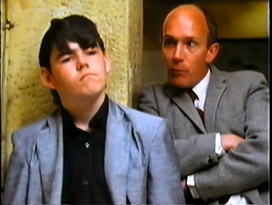
Hugh Ross is good value as another of the boys teachers, showing serious bigotry when it comes to the youngsters playing football. To some younger viewers this could seem far fetched, but I knew of teachers not far removed from this. Ross may be better known to genre fans, with him memorably playing Narcisse in Clive Barker's cult horror Nightbreed (1990). However, this is just one role, with him featuring in countless movies and television shows throughout the years.

Fans of Taggart (1983) will be happy to see Alex Norton make an appearance as one of the young boys' uncles. Norton brings an air of realism to proceedings, although saying this, it is his character that gives the film its few scenes of whimsy as he retells some tall tales to McFadyn’s Nick.
Eagle eyed viewers may also notice a brief appearance from City Lights’ (1984) very own Gerard Kelly, who features during the opening moments of the film as Nick’s father. The only other time we see him is through a photograph that Nick keeps in his room.
By this point in his career, Kelly was pretty well established, so it seems strange for him to make what is essentially a wordless cameo. Perhaps it was done as a favour to the filmmakers.
Sandy Johnson gives the film a naturalistic and gritty feel. There isn’t much in the way of “action”, but the threat of violence always seems to be a possibility. My one issue is the implementation of composer John Keane’s score. Now Keane is quite a prolific composer, notably providing music for shows like Kavanagh Q.C. (1996) and Inspector George Gently (2007). Unfortunately, this isn’t one of his better scores. Parts of the film the music fits the drama relatively well, but some scenes come across as comical, such as the musical cues used whenever the school bullies appear.
Unlike his lead actors, director Sandy Johnson went on to have quite an extensive career, mostly working in television. Episodes of Inspector Morse (1990), A Touch of Frost (1997) and most recently Beyond Paradise (2023) are just a handful of the shows that he has worked on. With a film like Leaving, it is sometimes better to have a director like Johnson. Someone I would call a no bullshit director, more focused on telling the story than trying to make the film look overly stylish. This approach actually pays off dividends, giving proceedings an air of authenticity. For more examples of this, viewers should check out the early collaborations of director John McKenzie and writer Peter McDougal.
Similarly, writer Daniel Boyle went on to work on several notable dramas. His filmography may not be as lengthy as Johnson’s but also went on to work on Inspector Morse (1991) as well as several notable Scottish set dramas such as Hamish Macbeth (1995), Taggart (2005) and Rebus (2006).
Copies of Leaving are harder to come by these days, but there are copies of it floating about YouTube, albeit in slightly poor quality. Even so, if this is the only version you have available, I would still recommend giving it a watch.
Rating: 4/5


Comments